OECD Common Reporting Standard
CRS reporting, without the XML
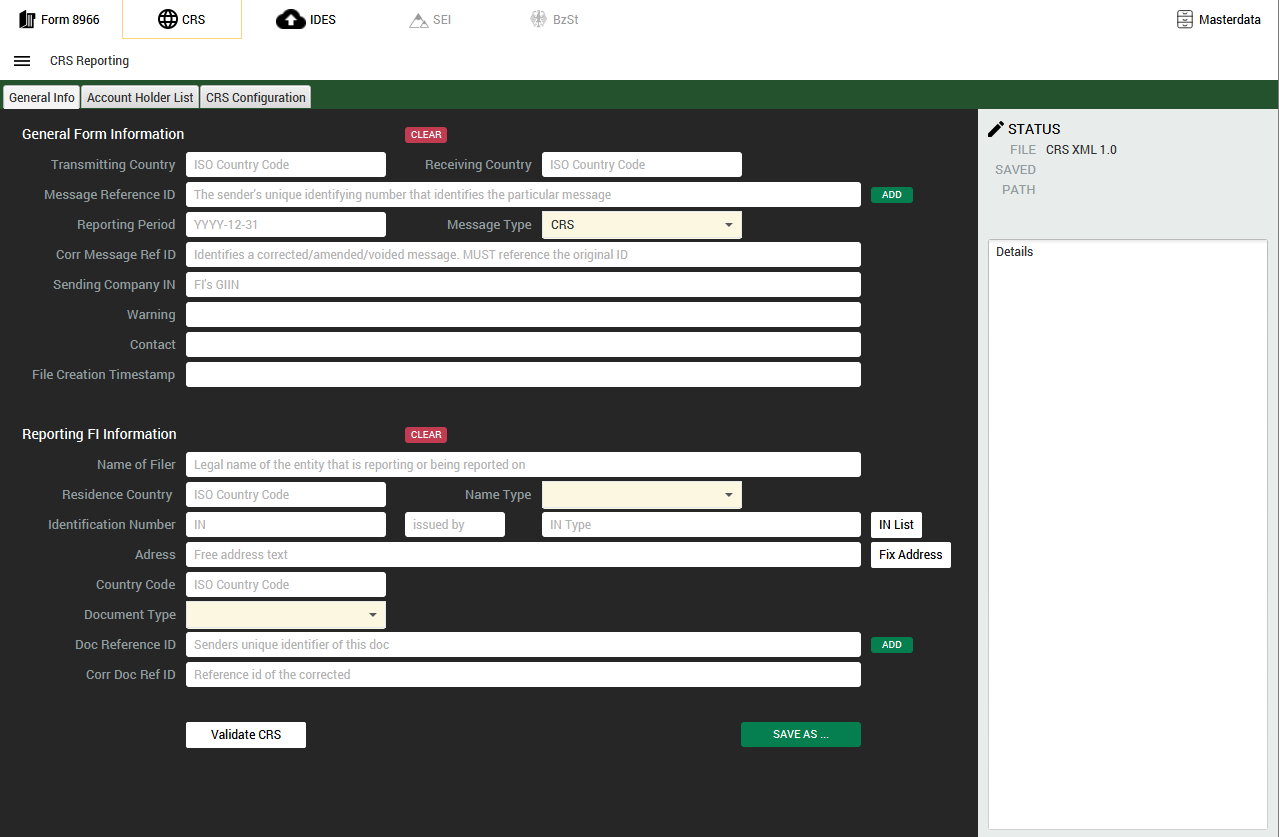
TRSuite turns account data into schema-valid CRS XML – the OECD schema in version 2.0 and 3.0, plus the domestic formats and delivery channels of the jurisdictions that define their own.
- CRS XML 3.0 reads 1.0, 2.0 and 3.0, writes 2.0 and 3.0
- 40 jurisdictions with their own rule set
- Perpetual licence unlimited reporting FIs
What the Common Reporting Standard asks of you
The Common Reporting Standard, formally the Standard for Automatic Exchange of Financial Account Information in Tax Matters, is the OECD’s global answer to the question FATCA raised: where do your customers pay tax, and who needs to know? It borrows heavily from the Model 1 FATCA IGA, but the differences matter – and they sit precisely where the work is: cross-border identification, classification and reporting of customer accounts.
A financial institution has to establish the tax residence of every single customer and be able to hand the resulting information to the relevant tax authority, in the format that authority expects. The OECD schema was designed so that it can serve domestic reporting as well, and many jurisdictions use it unchanged – but not all of them.
CRS 3.0 (the “Amended CRS”) changes the data you have to collect. Self-certification, due diligence procedure, account type, equity interest type and joint account count are new mandatory or newly typed elements, and controlling persons became a repeating structure. Jurisdictions switch at different dates – the Isle of Man from 1 October 2026, most others from 1 January 2027. TRSuite writes both 2.0 and 3.0, so you can move when your authority does, not before.
What the CRS module does
One licence, all jurisdictionsCapture and import
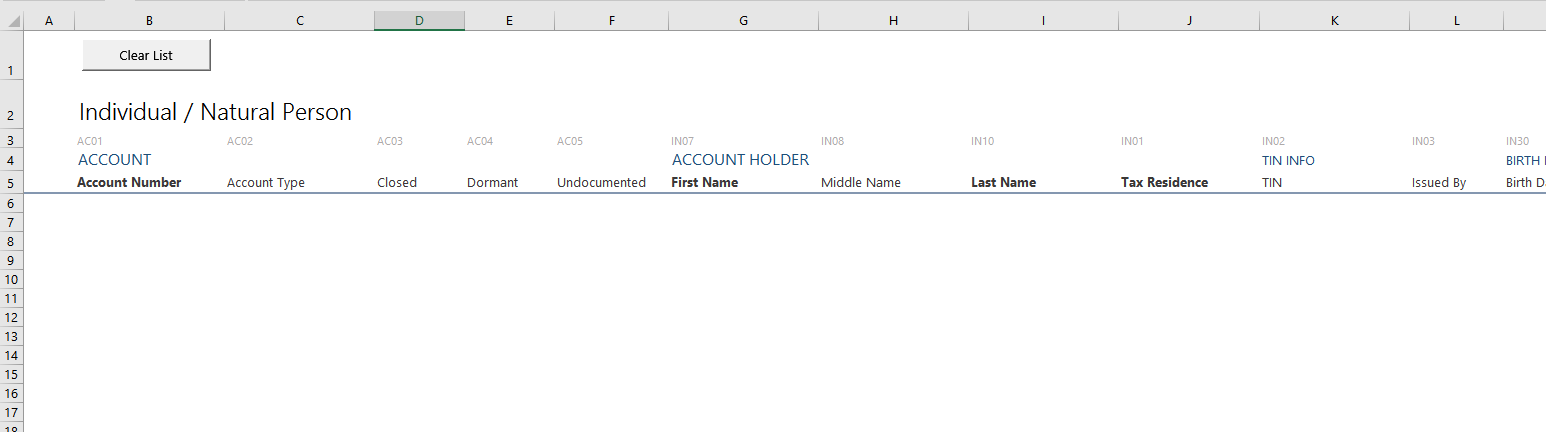
Type the data into the application, import it from an existing CRS XML file, or collect it in the supplied Excel workbooks – with a data entry form and a “Check data” button that flags problems before the import.
Validate before you file
Every report is checked against the XSD and against the rule set of the receiving jurisdiction: TIN formats and check digits, DocRefID conventions, mandatory fields, amount and date formats, forbidden character sequences.
Correct, amend and void
Reference a previously filed report and produce a correction, an amendment or a void message. TRSuite keeps track of the document references so the authority can match your correction to the original.
Domestic formats and delivery
Where a jurisdiction defines its own schema or upload channel – Austria, Hong Kong, Macau, Malaysia, Canada, Curaçao, Luxembourg, Switzerland – a country module extends the standard one with the extra data and the delivery steps.
Documentation for your file
Produce a PDF of what was reported, as one document or one file per account holder, with the option to hash the names out of the file names when the PDFs leave the building.
CARF in the same tool
The OECD Crypto-Asset Reporting Framework (CARF XML 1.0) is a module of TRSuite as well – same application, same working style, same licence model, and a discount on every module you add to an existing licence.
Inside the application
A trial licence with the full functionality is available for ten days.




Rule sets instead of guesswork
Jurisdictions take their own decisions when they implement the OECD standard: which TIN formats they accept, how a document reference has to be built, which character sequences their portal rejects, whether a nil report is expected at all. TRSuite ships those decisions as configuration packages, so a report destined for Hong Kong is checked by Hong Kong’s rules and one destined for Macau by Macau’s.
The supported countries page lists every jurisdiction we cover, what the module does for it, and where a limitation applies – including the jurisdictions whose authority has not published a CRS 3.0 schema yet.
Pricing and licence
USD · valid from 1 January 2026All prices exclude VAT. Perpetual licence, one year of premium support and maintenance included.
| Users | FATCA / IDES | CRS | CARF |
|---|---|---|---|
| 1-3minimum licence | 1'269.- | 1'269.- | 1'269.- |
| 4-10* | 395.- | 395.- | 395.- |
| 11-20* | 299.- | 299.- | 299.- |
| 21-50* | 275.- | 275.- | 275.- |
| 50+* | 235.- | 235.- | 235.- |
| Corporateunlimited use within the company | 15'500.- | 15'500.- | 15'500.- |
| Libraryembedding into your own software | 7'500.- | 7'500.- | 7'500.- |
| Source codeone-off transfer | 24'900.- | 24'900.- | 24'900.- |
| Individualtailored scope | request quote | request quote | request quote |
Multi-module discount
FATCA, CRS and CARF are separate modules of the same application. Combine them and every further module comes at a reduced licence price.
- Second module−10%
- Third module−25%
- Fourth and every further module−40%
The discount applies to the licence price of each additional module, ordered for the same number of named users. Tell us which combination you need and we will quote it.
Renewal discount
Lock in today's price and stretch the budget: prepay several years of premium support and maintenance.
- Two-year prepaid renewal−3%
- Three-year prepaid renewal−5%
Discount on the annual maintenance fee. Renewals always run from the support expiry date.
Perpetual licence
Software licences and the use of the products do not expire. One year of premium support and maintenance is included with every new perpetual licence. Premium support covers all new releases, new features and product updates free of charge, plus professional email support.
Premium support and maintenance
The annual renewal costs 40% of the full regional price of a new licence at the time of renewal, for each product bought under a perpetual licence. Multi-year renewals lock in the current price at the discount shown above. A running support contract can be extended at any time within its term under the conditions then in force; renewals always start from the support expiry date.
Named user
Licences are counted by user, not by concurrent session: if five employees may use the system, five licences are needed. The minimum for TRSuite is three named users per module; from the fourth user on, every additional user is charged at the rate of the band that user falls into. Reporting financial institutions, GIINs and jurisdictions are unlimited.
One tool, several standards
FATCA, CRS and CARF are licensed as separate modules and run side by side in the same application, with the same working style and the same data entry and import routes. Adding a module to an existing licence earns the multi-module discount above; existing licences can be consolidated onto one renewal date.
Corporate
Unlimited use of the program throughout the organisation - typically the better choice from about 50 users onwards.
Try it before you buy it
A trial licence with the full functionality, valid for ten days, and free evaluation support while you use it. Create your CRS report today.
Reference material
- Common Reporting Standard OECD – standard, schema and user guide
- CRS implementation and assistance OECD – participating jurisdictions and exchange relationships
- Supported countries in TRSuite Which jurisdiction is covered, and how
- Release notes What changed in each version